
Understanding the Hidden Cost of Oversized HVAC Systems
We often see homeowners assume that a bigger HVAC system means better comfort and performance. In reality, oversized HVAC systems are one of the most common and expensive mistakes in residential and light commercial heating and cooling. Oversizing leads to premature equipment failure, higher energy bills, inconsistent indoor comfort, and unnecessary maintenance costs. Properly sized systems, on the other hand, operate efficiently, last longer, and provide stable, balanced indoor temperatures year-round.
An HVAC system must be designed to match the exact thermal load of the building, not exceed it. When capacity exceeds demand, the system works against itself, shortening its lifespan and diminishing its value from day one.
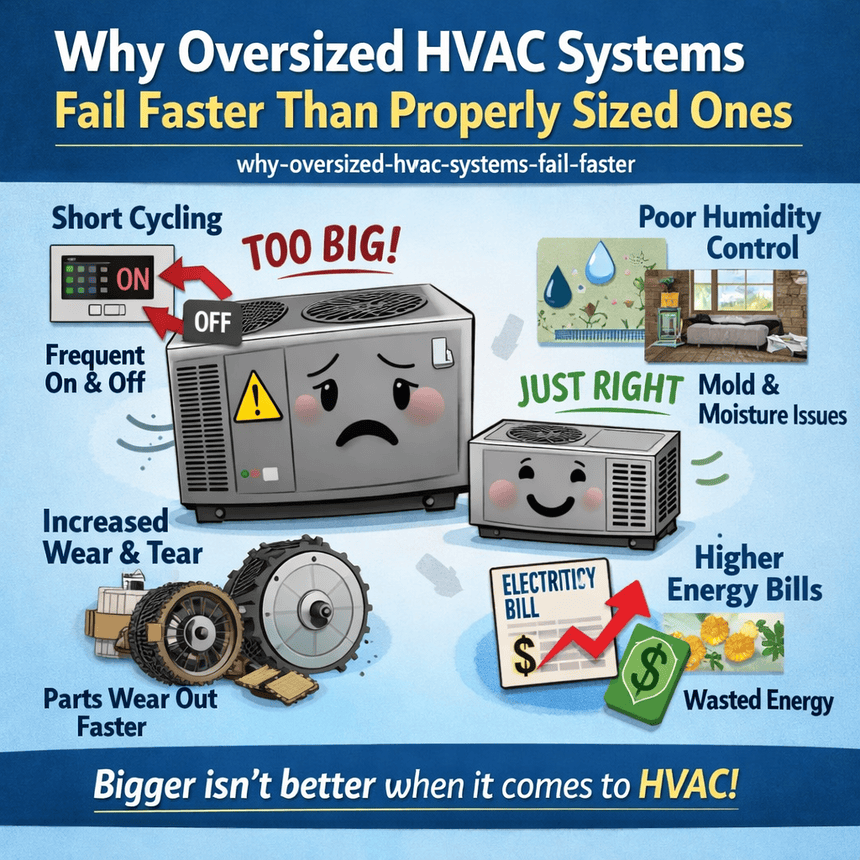
Short Cycling: The Primary Reason Oversized HVAC Systems Fail Early
One of the most damaging effects of an oversized HVAC unit is short cycling. Short cycling occurs when the system turns on and off too frequently because it reaches the thermostat setpoint too quickly.
This repeated cycling causes:
- Excessive wear on compressors
- Increased electrical stress on contactors and capacitors
- Higher startup current draw
- Reduced operational efficiency
Compressors are designed for long, steady run times. When forced to start and stop repeatedly, internal components degrade rapidly, leading to compressor burnout years earlier than expected.
Inconsistent Indoor Comfort and Temperature Swings
Oversized HVAC systems do not maintain stable indoor conditions. Instead, they produce rapid temperature swings that leave occupants uncomfortable.
Common comfort issues include:
- Rooms that feel cold and clammy in summer
- Uneven temperatures between floors
- Hot and cold spots throughout the home
- Poor humidity control
Because the system shuts off too quickly, air does not circulate long enough to equalize temperatures across all rooms. Properly sized systems run longer cycles, allowing air to distribute evenly and consistently.
Humidity Control Failure in Oversized Systems
Humidity regulation is a critical function of any HVAC system, especially in cooling mode. Oversized systems fail at this task.
When cooling cycles are too short:
- Moisture is not fully removed from the air
- Indoor humidity remains elevated
- Mold and mildew risk increases
- Indoor air quality declines
A properly sized HVAC system removes humidity gradually and consistently, creating a healthier and more comfortable indoor environment. Oversized units simply cool the air without properly dehumidifying it.
Higher Energy Consumption and Utility Costs
Contrary to popular belief, oversized HVAC systems consume more energy, not less. Frequent starts require high electrical current, which significantly increases power usage.
Energy inefficiencies include:
- Increased peak demand charges
- Higher electrical consumption during startup
- Reduced Seasonal Energy Efficiency Ratio (SEER)
- Poor fuel utilization in heating mode
Properly sized systems operate closer to their design efficiency, delivering lower monthly utility bills and reduced long-term operating costs.
Accelerated Component Wear and Mechanical Failure
Oversized HVAC equipment places continuous stress on internal components. Over time, this leads to:
- Premature compressor failure
- Blower motor overheating
- Worn bearings and belts
- Cracked heat exchangers
- Repeated control board failures
Each startup introduces mechanical shock. Oversized systems experience hundreds more startups per year than correctly sized systems, drastically reducing equipment lifespan.
Increased Maintenance and Repair Frequency
Because oversized systems operate inefficiently, they require more frequent service calls. Common repair issues include:
- Failed capacitors
- Burned contactors
- Refrigerant imbalance
- Sensor and thermostat errors
- Condensate drainage problems
The cumulative cost of repeated repairs often exceeds the price difference between a properly sized system and an oversized one within just a few years of operation.
Why Proper HVAC Sizing Extends System Lifespan
Correct sizing is based on accurate load calculations, not guesswork. Properly sized HVAC systems are engineered to match the building’s real heating and cooling demand.
Key benefits include:
- Longer run cycles with fewer starts
- Reduced mechanical stress
- Stable indoor temperatures
- Improved humidity control
- Lower energy consumption
- Extended equipment lifespan
Systems sized correctly often last 5 to 10 years longer than oversized installations.
The Role of HVAC Load Calculations
Accurate HVAC sizing depends on professional load calculations, commonly known as Manual J calculations. These calculations consider:
- Building square footage
- Insulation levels
- Window size and orientation
- Air leakage
- Ceiling height
- Occupancy patterns
- Local climate conditions
Skipping this step results in oversizing, inefficiency, and premature failure. Precision sizing ensures that the system performs exactly as intended under real-world conditions.
Oversized Heating Systems Are Equally Problematic
Oversizing is not limited to air conditioners. Heating systems that are too large also fail prematurely.
Common heating-related issues include:
- Cracked heat exchangers due to rapid temperature changes
- Frequent burner cycling
- Reduced combustion efficiency
- Excessive fuel consumption
Properly sized heating systems deliver steady heat output, maintain safe operating temperatures, and reduce wear on critical components.
Financial Impact of Oversized HVAC Systems
Oversized HVAC systems create a long-term financial burden through:
- Higher upfront installation costs
- Increased monthly utility bills
- More frequent repairs
- Early system replacement
In contrast, properly sized systems provide predictable operating costs and better return on investment, making them the financially responsible choice.
Why Bigger Is Not Better in HVAC Design
HVAC performance is not about maximum capacity—it is about balance and precision. Bigger systems sacrifice efficiency, comfort, and longevity for the illusion of power.
Correct sizing ensures:
- Continuous, efficient operation
- Stable indoor comfort
- Lower environmental impact
- Reduced carbon footprint
- Maximum equipment durability
Choosing Long-Term Performance Over Short-Term Assumptions
We design HVAC systems for real performance, not assumptions. Oversizing may seem like a safety margin, but it creates mechanical stress, energy waste, and comfort problems that compound over time.
Proper sizing delivers quiet operation, consistent temperatures, controlled humidity, and dependable performance year after year.
Final Thoughts on HVAC System Longevity
Oversized HVAC systems fail faster because they are forced to operate outside their optimal performance range. Short cycling, excessive wear, poor humidity control, and high energy consumption all contribute to early failure.
Properly sized HVAC systems operate smoothly, efficiently, and reliably. They last longer, cost less to operate, and provide superior indoor comfort. Precision sizing is not optional—it is essential for system longevity and performance.