
Introduction: Why Temperature Imbalance Is One of Saskatchewan Homeowners’ Biggest Comfort Issues
In many SK homes, homeowners experience a persistent and frustrating problem: some rooms never reach the thermostat’s set temperature, no matter how long the heating or cooling system runs. Bedrooms feel chilly while living rooms overheat. Basements stay cold in winter, and upper floors trap heat in summer. This issue is not random, seasonal, or inevitable—it is the direct result of hidden airflow, design, and system performance problems that compound over time.
Understanding the real reason temperature imbalances happen is the first step toward restoring comfort, efficiency, and long-term system reliability. This article breaks down the true causes behind uneven room temperatures in Saskatchewan homes, focusing on climate-specific challenges, building science, and HVAC performance factors that directly impact how heat and air move through a home.
Why Saskatchewan Homes Are Especially Prone to Temperature Imbalance
Extreme Climate Magnifies Small HVAC Issues
Saskatchewan experiences long, severe winters and wide seasonal temperature swings, placing heavy demands on heating systems. When outdoor temperatures plunge well below freezing, even minor airflow or insulation flaws become major comfort issues.
In milder climates, uneven airflow may go unnoticed. In SK, however, any inefficiency is amplified, causing some rooms to lag far behind the thermostat setting.
Thermostats Only Measure One Location
Most homes rely on a single thermostat, typically located in a central hallway or living area. The thermostat regulates the entire system based on that one spot—not the coldest or warmest room.
As a result:
- Rooms far from the thermostat may be underheated
- Sun-exposed rooms may overheat
- Basements and additions often fall outside the comfort zone
This creates a false sense of system performance, where the thermostat is satisfied while occupants are not.
The Core Problem: Airflow Distribution, Not Furnace Size
Airflow Imbalance Is the Primary Culprit
The most common and overlooked reason rooms never reach set temperature is uneven airflow distribution. Heating and cooling systems rely on precise airflow delivery. When airflow is restricted, misdirected, or poorly balanced, temperature control fails at the room level.
Key airflow issues include:
- Ducts delivering too little air to distant rooms
- Excess airflow dumping into rooms closest to the furnace
- Poor return air placement preventing proper circulation
Without balanced airflow, even a high-efficiency system cannot maintain consistent temperatures.
Long Duct Runs Reduce Heat Delivery
Rooms located far from the furnace—such as upper floors, basements, or home additions—often suffer from long duct runs. Over distance, air loses pressure and heat, arriving weaker and cooler than intended.
In older SK homes, duct systems were often designed without accounting for:
- Modern insulation standards
- Renovations or layout changes
- Increased comfort expectations
The result is structural under-delivery of conditioned air to specific rooms.
Hidden Ductwork Problems That Sabotage Comfort
Leaky Ducts Waste Heat Before It Reaches the Room
Duct leakage is a silent energy thief. Small gaps, loose joints, or deteriorated seals allow heated air to escape into walls, attics, or basements before reaching living spaces.
In cold climates like Saskatchewan:
- Lost heat never benefits the home
- Furnaces run longer to compensate
- Some rooms remain perpetually cold
Even minor duct leaks can cause major temperature imbalance.
Improperly Sized or Crushed Ducts
Ductwork must be sized precisely to deliver the correct airflow volume. Undersized ducts restrict airflow, while crushed or kinked ducts—common in basements and renovations—reduce delivery even further.
Symptoms include:
- Weak airflow at vents
- Noisy ducts or whistling sounds
- Rooms that never warm up despite long run times
Insulation Gaps Create Cold Zones That HVAC Can’t Overcome
Poor Insulation Overpowers Heated Air
In Saskatchewan homes, insulation quality directly determines room comfort. Rooms with inadequate wall, attic, or floor insulation lose heat faster than the system can replace it.
Common problem areas include:
- Bonus rooms over garages
- Older basements
- Exterior corner rooms
- Home additions built to outdated standards
Even with proper airflow, heat escapes too quickly, preventing the room from reaching set temperature.
Air Sealing Is Just as Important as Insulation
Drafts from windows, doors, electrical outlets, and rim joists introduce cold air continuously. This forces the heating system to fight an uphill battle, especially in rooms exposed to prevailing winter winds.
Without proper air sealing, temperature control becomes unstable and inefficient.
Return Air Placement: The Overlooked Half of Comfort
Rooms Without Return Air Stay Cold
Every supply vent needs a path for air to return to the furnace. Rooms lacking adequate return air pathways trap cold air, preventing circulation.
Common signs include:
- Cold bedrooms with closed doors
- Pressure differences when doors open or close
- Stuffy or stale air in specific rooms
Without proper return airflow, heated air cannot replace cold air effectively.
Closed Doors Disrupt System Balance
When doors are closed, airflow can drop dramatically if no return vent or transfer grille exists. This is especially problematic in winter, when closed bedrooms are common at night.
System Design Flaws That Limit Room-Level Control
Single-Zone Systems Can’t Adapt to Room Differences
Most SK homes operate on single-zone HVAC systems, meaning one thermostat controls the entire house. This design assumes uniform heat loss across all rooms—an assumption that rarely holds true.
Factors that break this assumption include:
- Sun exposure differences
- Ceiling height variations
- Room usage patterns
- Exterior wall exposure
Without zoning or airflow balancing, some rooms will always lag behind.
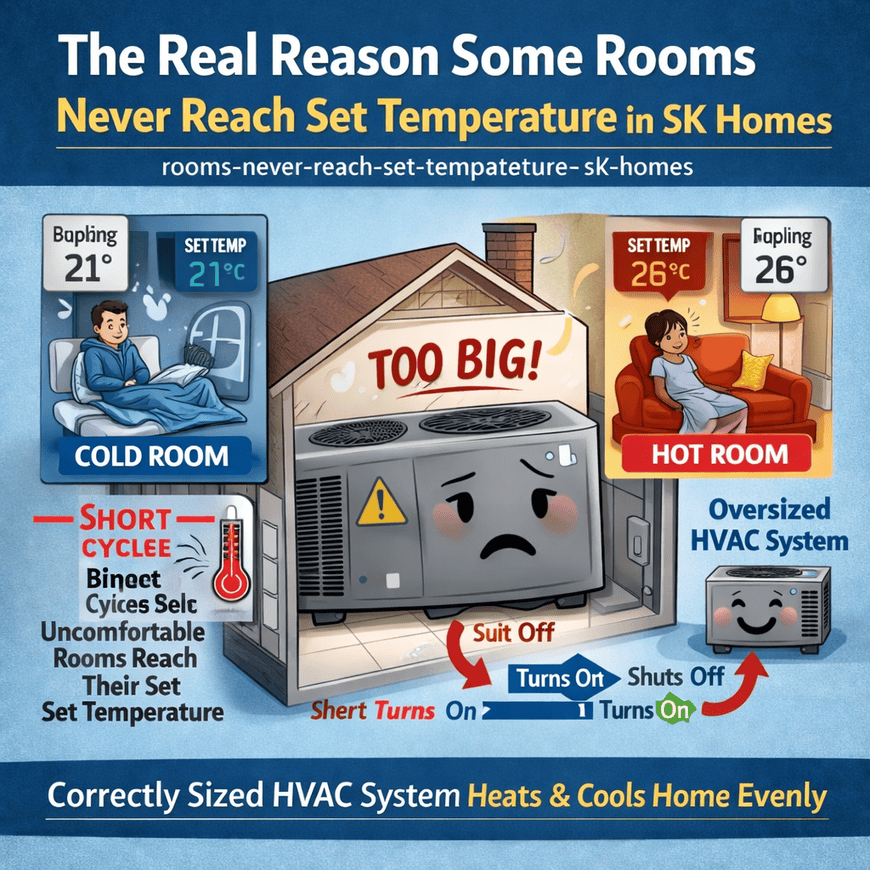
Oversized Systems Short-Cycle and Miss Cold Rooms
When a furnace is oversized, it heats the thermostat location too quickly and shuts off before distant rooms warm up. This leads to:
- Frequent on-off cycling
- Uneven temperatures
- Reduced system lifespan
Contrary to popular belief, bigger systems do not solve comfort issues.
Why Adjusting the Thermostat Never Fixes the Problem
Raising the thermostat setting only overheats already-warm areas while leaving cold rooms unchanged. This increases energy bills, strains equipment, and fails to address the underlying cause.
True comfort requires:
- Balanced airflow
- Proper insulation
- Correct system design
- Strategic return air placement
How Professionals Diagnose Temperature Imbalance in SK Homes
Airflow Testing and Room-by-Room Analysis
Professional HVAC assessments involve:
- Measuring airflow at each vent
- Evaluating duct pressure and leakage
- Identifying insulation gaps
- Analyzing room heat loss
This data-driven approach pinpoints the exact reason rooms fall short of set temperature.
Load Calculations Reveal Structural Heat Loss
Room-by-room load calculations account for:
- Window size and orientation
- Insulation values
- Square footage
- Air leakage rates
This ensures heating capacity matches real-world demand.
Long-Term Solutions That Actually Work
Air Balancing and Duct Optimization
Adjusting dampers, resizing ducts, and sealing leaks restores proper airflow to underperforming rooms.
Zoning Systems for Precision Control
Zoned HVAC systems allow different areas of the home to maintain independent temperatures, solving chronic imbalance issues permanently.
Insulation and Air Sealing Upgrades
Targeted insulation improvements dramatically reduce heat loss, making temperature control achievable without increasing system size.
Conclusion: Comfort Starts With Understanding the Real Cause
When rooms never reach the set temperature in SK homes, the issue is rarely the thermostat and almost never solved by replacing equipment alone. The real reason lies in airflow imbalance, duct design flaws, insulation gaps, and system limitations that work together to undermine comfort.
Addressing these root causes restores:
- Consistent room temperatures
- Lower energy bills
- Quieter operation
- Longer system lifespan
True comfort is not accidental—it is engineered, balanced, and built on understanding how heat actually moves through a home.