
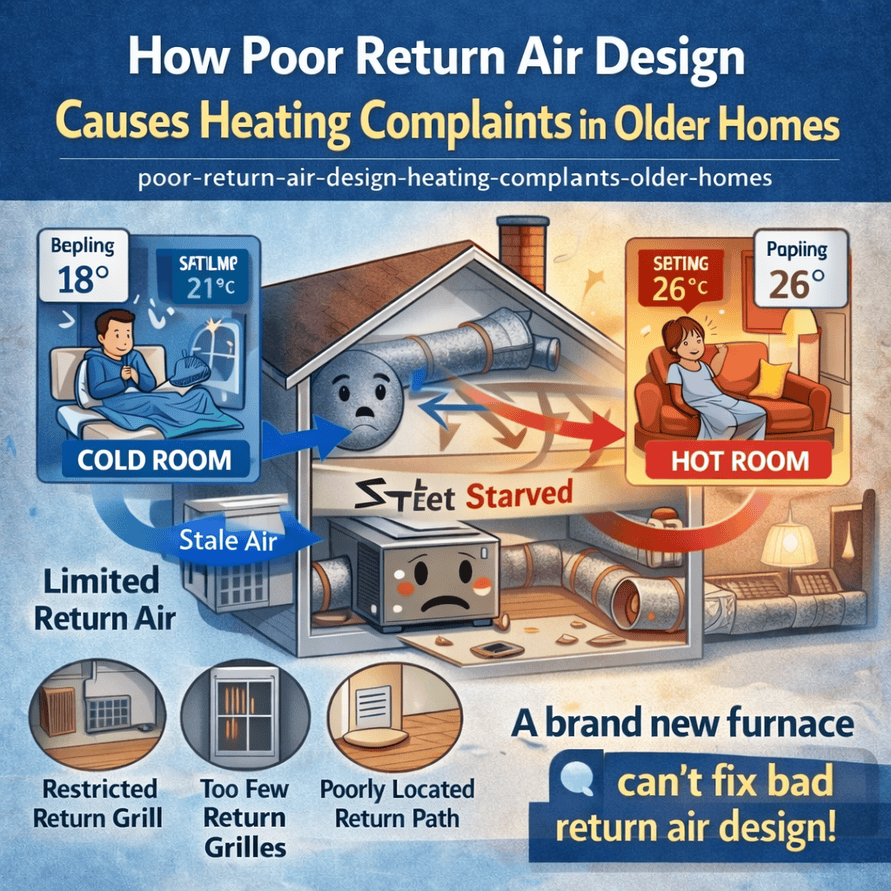
Older homes carry character, craftsmanship, and history—but they also carry hidden heating problems that modern homeowners often struggle to understand. One of the most overlooked and most damaging causes of heating complaints in older homes is poor return air design. While furnaces, boilers, and thermostats often get blamed, the real issue frequently lies in how air is pulled back to the heating system.
We see this problem repeatedly: rooms that never warm up, cold floors, noisy airflow, uneven temperatures, and rising energy bills. These are not equipment failures—they are airflow failures. Below, we explain in depth how inadequate return air systems in older homes silently sabotage comfort, efficiency, and performance.
Understanding Return Air: The Backbone of Heating Performance
Every forced-air heating system relies on a balanced air loop. Heated air is supplied into rooms, and return air pulls cooler air back to the furnace to be reheated. When return air is restricted, poorly located, undersized, or missing entirely, the system cannot operate as designed.
In older homes, return air was often treated as an afterthought. Builders focused on heat delivery but ignored air recovery, assuming heat would “find its way back.” This outdated assumption is the root cause of countless comfort complaints.
Why Older Homes Are Especially Vulnerable
Design Standards Were Different
Many older homes were built before modern airflow standards existed. Returns were:
- Centralized instead of room-based
- Undersized for today’s airflow demands
- Located in hallways rather than occupied spaces
- Completely absent on upper floors or basements
Renovations Made It Worse
Over time, homeowners added:
- New walls and finished basements
- Tighter windows and insulation
- Room additions without HVAC redesign
These changes block natural air pathways, turning marginal return air systems into major liabilities.
Common Heating Complaints Linked to Poor Return Air Design
Cold Bedrooms and Living Spaces
Rooms without dedicated return air struggle to circulate warm air. Heat enters but cannot escape, causing pressure imbalance and temperature stagnation.
Hot Hallways, Cold Rooms
Central returns pull air from hallways while bedrooms remain isolated. This creates false thermostat readings and uneven heating.
Noisy Airflow and Whistling Doors
Restricted return paths cause pressure buildup. Air forces its way under doors, through wall cavities, and around trim—creating noise and discomfort.
Short Cycling and Furnace Stress
When return air is insufficient, furnaces overheat internally and shut down early. This leads to frequent cycling, reduced lifespan, and higher repair costs.
The Physics Behind the Problem: Pressure and Airflow
Heating systems do not “push heat into rooms.” They circulate air. When return air is restricted:
- Supply air pressurizes rooms
- Pressure prevents new warm air from entering
- Heat output drops despite full furnace operation
This is why increasing thermostat settings does nothing. The system is already working at maximum capacity—but airflow imbalance prevents comfort.
Why Bigger Furnaces Do Not Fix Return Air Problems
A common mistake in older homes is installing a larger furnace to compensate for cold rooms. This worsens the issue.
Oversized equipment:
- Moves air faster than returns can handle
- Increases noise and pressure imbalance
- Shortens run cycles and efficiency
- Exacerbates uneven heating
Return air design—not furnace size—determines comfort.
Hidden Return Air Deficiencies in Older Homes
Single Central Return
One return grille for an entire floor cannot support modern airflow needs.
No Returns in Bedrooms
Closed doors isolate rooms, trapping air and causing temperature swings.
Basements Without Returns
Finished basements become chronically cold because heated air has no path back.
Returns Blocked by Furniture or Rugs
Older grilles are often placed low and easily obstructed.
How Poor Return Air Impacts Energy Bills
Restricted return airflow forces systems to:
- Run longer to achieve set temperature
- Cycle repeatedly due to overheating
- Operate at lower efficiency
The result is higher gas or electric bills with less comfort—a common complaint among owners of older homes.
Health and Indoor Air Quality Consequences
Poor return air does more than affect temperature. It also:
- Traps dust and allergens in rooms
- Reduces filtration effectiveness
- Increases humidity imbalance
- Encourages stale air and odors
Balanced return air is essential for healthy indoor air circulation, not just heating.
Professional Solutions That Actually Work
Room-by-Room Return Design
Each major living space should have a defined air return path—either direct or via transfer grilles.
Additional Return Ducting
Strategically added returns dramatically improve comfort without replacing equipment.
Jump Ducts and Transfer Grilles
Ideal for older homes where new duct runs are limited.
Pressure Testing and Airflow Measurement
Professionals identify imbalances using static pressure diagnostics rather than guesswork.
Why This Problem Is So Often Misdiagnosed
Many heating complaints are wrongly attributed to:
- Furnace age
- Thermostat malfunction
- Insulation quality
Without airflow testing, return air failures remain invisible. Homeowners replace equipment repeatedly while comfort never improves.
Signs Your Home Suffers From Poor Return Air Design
- Temperature differences between rooms exceed 3–4 degrees
- Doors move or slam when the furnace runs
- Whistling sounds near door frames
- Furnace runs frequently but rooms stay cold
- Heating complaints worsen after renovations
These are airflow red flags, not equipment failures.
Long-Term Value of Correcting Return Air Design
Fixing return air issues delivers:
- Even, consistent room temperatures
- Lower heating costs
- Quieter system operation
- Longer furnace lifespan
- Improved air quality
It is one of the highest ROI upgrades for older homes—often without replacing the heating system.
Why We Prioritize Return Air in Older Home Heating Solutions
We focus on airflow first, equipment second. When return air is properly designed:
- Heating systems operate as intended
- Comfort complaints disappear
- Energy efficiency improves immediately
Older homes do not need more heat—they need better air movement.
Final Thoughts: Comfort Starts With the Air You Don’t See
Poor return air design is the silent culprit behind most heating complaints in older homes. Until airflow is balanced, no furnace—no matter how advanced—can deliver consistent comfort.
When heating problems persist despite upgrades, the answer is almost always hidden behind walls, doors, and duct paths. Fix the return air, and the comfort follows.