
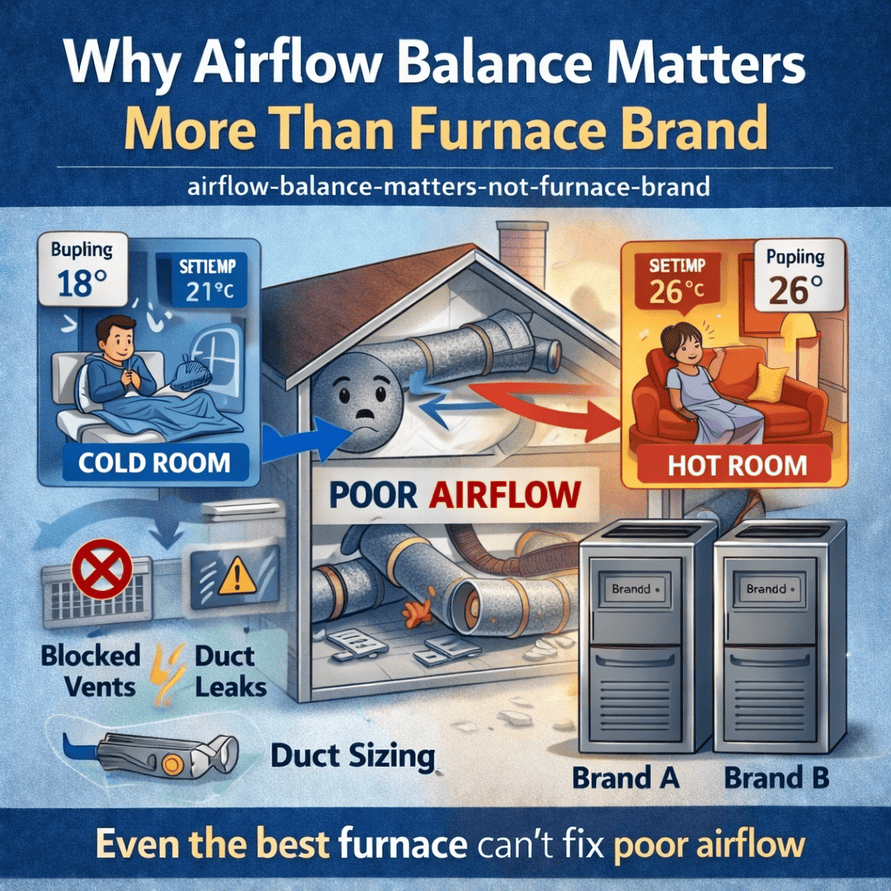
When homeowners think about heating performance, efficiency, and comfort, attention is often drawn to furnace brand names, efficiency ratings, and advanced features. While equipment quality certainly plays a role, airflow balance is the silent force that ultimately determines how well any heating system performs. We consistently see that even the most premium furnace will fail to deliver comfort, efficiency, and longevity if airflow is poorly designed or improperly balanced.
Airflow balance is not an accessory to heating performance—it is the foundation. Without it, furnaces underperform, energy costs rise, and comfort becomes inconsistent. This article explains why balanced airflow matters more than the furnace brand itself, and how addressing airflow delivers superior results regardless of equipment manufacturer.
Understanding Airflow Balance in Heating Systems
Airflow balance refers to the even and controlled distribution of heated air throughout a home. This balance is achieved when supply air and return air are properly matched, ductwork is correctly sized, and air pressure remains stable across all rooms.
A balanced system ensures:
- Consistent temperatures in every space
- Proper heat transfer at the furnace heat exchanger
- Stable system pressures that protect components
- Efficient energy usage without waste
When airflow is unbalanced, heat may be produced efficiently at the furnace but never delivered effectively to living spaces.
Why Furnace Brand Alone Cannot Deliver Comfort
Furnace manufacturers design equipment to operate within specific airflow ranges. These units assume that:
- Ductwork is correctly sized
- Returns are adequate
- Static pressure remains within design limits
When these conditions are not met, even a top-tier furnace is forced to operate outside its optimal range. This leads to:
- Short cycling or extended run times
- Overheated heat exchangers
- Reduced efficiency and increased wear
The result is a system that performs no better—or sometimes worse—than a budget unit installed with proper airflow.
Airflow Imbalance: The Hidden Cause of Comfort Problems
Many common heating complaints stem directly from airflow imbalance rather than equipment failure.
Uneven Room Temperatures
Hot and cold rooms are almost always the result of poor air distribution, not furnace output. Inadequate supply airflow or undersized returns prevent heat from reaching distant or enclosed spaces.
Noisy Operation
Whistling vents, rattling ducts, and loud airflow are signs of excessive static pressure. This pressure buildup occurs when ducts are undersized or blocked, forcing air through restricted pathways.
Frequent Furnace Cycling
Improper airflow causes furnaces to reach temperature limits too quickly, triggering safety shutoffs and repeated cycling. This short cycling reduces efficiency and accelerates component failure.
How Balanced Airflow Improves Energy Efficiency
Balanced airflow directly impacts energy consumption. When airflow is optimized:
- Heat is delivered evenly with less runtime
- The furnace operates within its designed efficiency range
- Blower motors draw less power
- Heat loss through duct leakage is minimized
Conversely, unbalanced airflow forces the system to compensate through longer cycles and higher fan speeds, increasing energy usage without improving comfort.
Duct Design Matters More Than Equipment Labels
Ductwork is the circulatory system of a heating system. Its design determines whether heat reaches its destination efficiently.
Key duct factors include:
- Proper sizing to match furnace airflow requirements
- Smooth airflow paths with minimal restrictions
- Balanced branch runs to each room
- Adequate return air pathways
Oversized furnaces connected to undersized ducts are one of the most common causes of system failure. In contrast, a modest furnace paired with well-designed ductwork often outperforms premium units installed on flawed distribution systems.
The Role of Return Air in Airflow Balance
Return air is just as important as supply air. Without sufficient return pathways, air cannot circulate properly, leading to pressure imbalances.
Common return air issues include:
- Too few return vents
- Returns located only in hallways
- Closed-off rooms without return access
Balanced systems provide low-resistance return paths from every major living space, allowing air to flow freely back to the furnace.
Static Pressure: The Metric That Defines System Health
Static pressure measures resistance to airflow within the system. Excessive static pressure indicates airflow restriction and is one of the most reliable indicators of system problems.
High static pressure leads to:
- Reduced airflow across the heat exchanger
- Overheating and safety shutdowns
- Increased blower motor strain
- Shortened equipment lifespan
Maintaining proper static pressure is far more critical to system longevity than selecting a specific furnace brand.
Why Airflow Balance Extends Furnace Lifespan
Balanced airflow reduces mechanical stress across all system components. When airflow is correct:
- Heat exchangers remain within safe temperature limits
- Blower motors operate at lower loads
- Limit switches are not constantly triggered
- Internal components experience less thermal stress
This translates directly into longer equipment life, fewer breakdowns, and lower maintenance costs.
Airflow Balance and Indoor Air Quality
Airflow balance also plays a vital role in indoor air quality. Proper circulation ensures:
- Even filtration of airborne particles
- Controlled humidity levels
- Reduced stagnation in closed rooms
- Better performance of air cleaners and humidifiers
Poor airflow allows contaminants to settle, humidity to build unevenly, and filtered air to bypass key living areas.
Professional Airflow Testing Delivers Real Results
True airflow balance cannot be achieved by guesswork. Professional evaluation includes:
- Static pressure measurement
- Airflow testing at each register
- Duct leakage assessment
- Return air analysis
These diagnostics identify airflow bottlenecks that brand upgrades alone cannot solve. Corrective measures such as duct resizing, additional returns, and airflow balancing often produce immediate comfort improvements without replacing the furnace.
Why Smart Homeowners Prioritize Airflow Over Branding
Homeowners focused solely on furnace brands often overlook the most impactful upgrade available. Balanced airflow:
- Enhances comfort more than brand upgrades
- Improves efficiency regardless of furnace type
- Protects investment in heating equipment
- Reduces long-term operating costs
In real-world performance, airflow design consistently outweighs brand selection.
Airflow Balance Is the True Performance Multiplier
Furnace brands compete on features, efficiency ratings, and technology. Airflow balance determines whether any of those advantages are realized. Without proper airflow, performance ratings remain theoretical.
When airflow is balanced:
- Budget furnaces perform like premium systems
- Premium furnaces reach their full potential
- Comfort becomes consistent and predictable
- Energy waste is eliminated at the source
Conclusion: Comfort Is Engineered Through Airflow
We have seen time and again that airflow balance matters more than furnace brand. Heating systems succeed or fail based on how effectively air is delivered, returned, and regulated throughout the home. Balanced airflow transforms heating performance, protects equipment, and delivers comfort that branding alone cannot guarantee.