
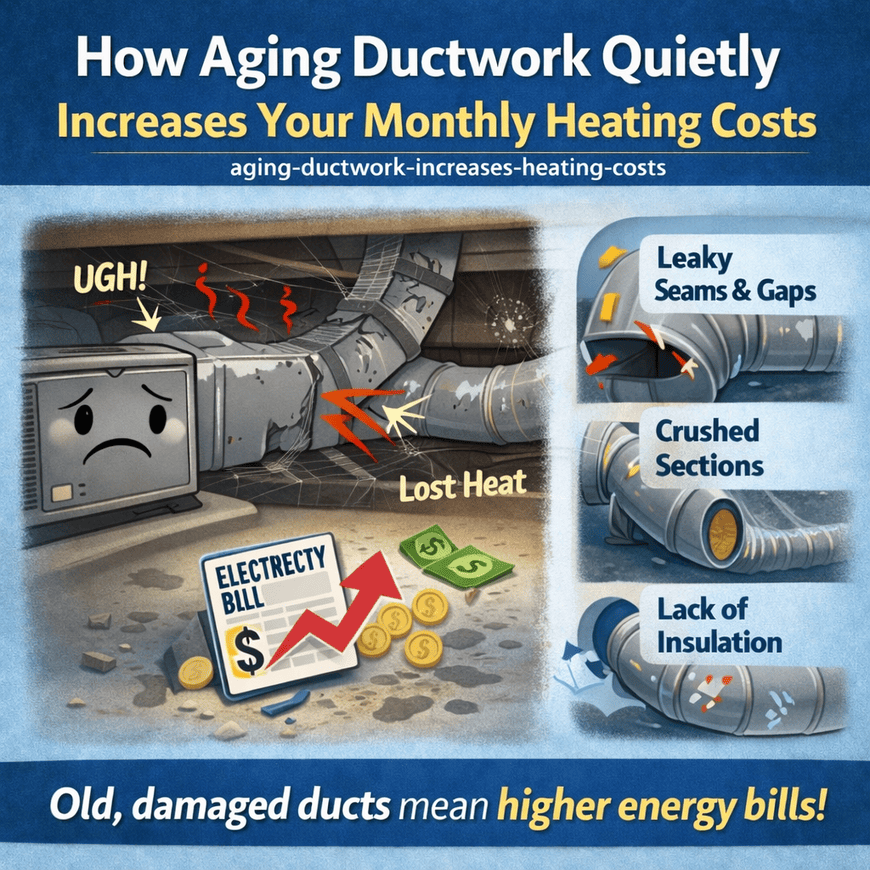
Heating costs rarely spike overnight. In most homes, they creep upward month after month, quietly draining money while comfort declines. One of the most overlooked contributors is aging ductwork. Hidden behind walls, ceilings, and floors, duct systems deteriorate slowly, and when they do, efficiency losses compound silently.
We see this issue repeatedly in residential properties where homeowners invest in new furnaces, upgraded thermostats, or insulation, yet still experience higher heating bills. The missing link is almost always the duct system. Below, we break down precisely how aging ductwork increases heating costs, where the losses occur, and why ignoring it guarantees long-term inefficiency.
The Role of Ductwork in Heating Efficiency
Ductwork is the circulatory system of a home’s heating setup. Heated air produced by the furnace must travel through ducts before reaching living spaces. When ducts are intact, sealed, and insulated, heat delivery is predictable and efficient.
When ducts age, however, thermal losses, pressure imbalances, and airflow restrictions emerge. These problems force the heating system to work longer and harder to maintain set temperatures, directly increasing monthly energy consumption.
Air Leakage: The Silent Heat Thief
One of the most damaging effects of aging ductwork is air leakage. Over time, duct joints loosen, sealants dry out, and metal expands and contracts with temperature changes. Even small gaps allow heated air to escape into unconditioned areas such as attics, crawlspaces, and wall cavities.
Industry testing consistently shows that 20%–30% of heated air can be lost through leaky ducts in older homes. That loss does not improve comfort; it simply raises utility bills.
Key cost drivers caused by duct leakage include:
- Longer furnace run times
- Increased fuel or electricity usage
- Uneven room temperatures
- Reduced system lifespan
Degraded Insulation and Heat Dissipation
Older duct systems often lack proper insulation, or the insulation has compressed, deteriorated, or fallen away entirely. When heated air travels through uninsulated ducts located in cold spaces, heat dissipates rapidly before it reaches occupied rooms.
This means:
- Supply air reaches rooms at lower temperatures
- Thermostats demand additional heating cycles
- Monthly heating costs increase incrementally
Modern insulation standards did not exist decades ago. As a result, many homes are unknowingly paying to heat attics, basements, and wall voids instead of living areas.
Restricted Airflow from Internal Duct Damage
Aging ductwork accumulates internal damage that restricts airflow. Common issues include:
- Collapsed flexible ducts
- Rusted or flaking metal interiors
- Dust and debris buildup
- Poorly designed transitions
Restricted airflow forces the heating system to push harder to deliver adequate air volume. This increases static pressure, which directly raises energy consumption and accelerates component wear.
The homeowner experiences higher bills, noisier operation, and inconsistent heat distribution without realizing the root cause is buried inside the duct network.
Pressure Imbalances and Energy Waste
As ducts age, air pressure balance deteriorates. Leaks on the supply side reduce delivered heat, while leaks on the return side pull cold, unconditioned air into the system. This imbalance results in:
- Drafty rooms
- Cold floors
- Hot ceilings
- Overheated mechanical rooms
The heating system compensates by running longer cycles, burning more fuel to overcome losses that should not exist.
Thermostat Misreading and Overheating
When ductwork loses efficiency, the thermostat receives inaccurate feedback. Rooms take longer to warm, prompting occupants to raise temperature settings unnecessarily. The system continues heating long after sufficient output would have been achieved with properly functioning ducts.
This behavior compounds energy waste and often leads homeowners to believe the furnace itself is underperforming, when the real issue lies downstream.
Aging Duct Materials and Structural Failure
Older homes frequently contain duct materials no longer recommended by modern standards. These include:
- Thin-gauge metal ducts prone to separation
- Asbestos-lined ducts
- Early-generation flex ducts with limited durability
As materials weaken, sections sag, joints split, and airflow paths degrade. Structural failure increases resistance, creates hot spots, and reduces system efficiency with every heating cycle.
Hidden Costs Beyond Monthly Bills
The financial impact of aging ductwork extends beyond utility statements. Prolonged inefficiency leads to:
- Shortened furnace lifespan
- Increased maintenance calls
- Higher repair frequency
- Premature equipment replacement
Replacing a furnace without addressing ductwork guarantees continued inefficiency, regardless of how advanced the new unit may be.
Why Ductwork Fails Before Homeowners Notice
Ductwork deterioration is gradual and invisible. Unlike furnaces or thermostats, ducts operate silently in concealed spaces. Homeowners adapt to temperature inconsistencies over time, accepting higher bills as unavoidable rather than recognizing a systemic failure.
This delayed awareness allows energy losses to accumulate year after year, often surpassing the cost of duct repair or replacement many times over.
Performance Testing Reveals the Truth
Professional diagnostics such as duct leakage testing, airflow measurement, and thermal imaging consistently expose hidden inefficiencies. Homes that undergo duct sealing or replacement routinely experience:
- Immediate heating cost reductions
- Improved temperature consistency
- Quieter system operation
- Faster warm-up times
The performance gains often exceed those achieved by furnace upgrades alone.
Modern Duct Systems Restore Efficiency
Upgrading aging ductwork restores system balance and unlocks full heating potential. Modern duct systems are:
- Fully sealed with advanced mastic compounds
- Properly insulated to current standards
- Sized to match equipment output
- Designed to optimize airflow
When ducts function correctly, heating systems operate within intended parameters, reducing energy consumption without sacrificing comfort.
Long-Term Financial Impact
Homes with optimized duct systems benefit from:
- Lower monthly heating bills
- Predictable energy usage
- Reduced mechanical stress
- Improved indoor air quality
The return on investment compounds over time, making duct upgrades one of the most cost-effective energy improvements available.
Conclusion: Aging Ductwork Is a Hidden Cost Multiplier
Heating systems cannot outperform the ductwork that delivers their output. Aging ducts quietly undermine efficiency, inflate monthly heating costs, and shorten system lifespan. Addressing ductwork issues transforms heating performance at the source, eliminating waste that homeowners often accept as inevitable.
Ignoring duct health guarantees continued financial loss. Correcting it restores control, comfort, and efficiency where it matters most.